Engineering-driven aluminum casting and precision manufacturing solutions

Category Quality Control
Dimensional inspection, material verification, traceability, and defect-prevention methods.
Water Immersion Leak Testing for Aluminum Gravity Castings

Leak testing is a critical quality control process for aluminum gravity castings used in pressure-tight applications, such as pump housings, valve bodies, hydraulic components, and other.
How First Article Inspection (FAI) Prevents Dimensional Variations in Aluminum Casting Mass Production

For high-precision applications such as 5G communication equipment, hydraulic systems, and new energy components, even minor dimensional changes can directly affect assembly performance and.
Why Is a Complete Quality Traceability System Important for Aluminum Castings

For industries such as automotive, industrial equipment, fluid control, new energy, and medical devices, aluminum castings must meet not only dimensional and performance requirements but.
Why Is Aluminum Alloy Composition Analysis Critical for High-Quality Aluminum Castings
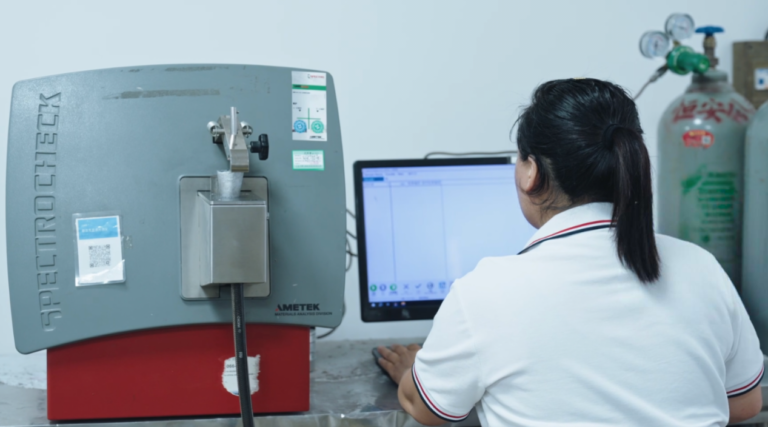
The mechanical properties of an aluminum casting begin with its material composition. Even when the casting process is well controlled, incorrect alloy chemistry can lead to reduced.
How to Properly Establish a Coordinate System for Aluminum Castings (CMM Inspection)

In dimensional inspection of aluminum alloy castings, the accuracy of the coordinate measuring machine (CMM) is only part of the equation. The reliability of the inspection results largely.
How Cross-Process Quality Control Prevents Defects in Aluminum Castings

Producing high-quality aluminum castings is not just about controlling the casting process itself. The final quality of a casting is influenced by every manufacturing stage-from mold design.
How to Ensure Traceable Quality in Aluminum Gravity Castings

For precision aluminum castings, product quality involves much more than dimensional accuracy. Material composition, internal integrity, mechanical properties, heat treatment, and surface.
How to Increase the Hardness and Tensile Strength of Aluminum Alloy Castings

The hardness and tensile strength of an aluminum alloy casting determine its load-bearing capacity, wear resistance, dimensional stability, and service life. For components used in.
How to Control Surface Roughness in Aluminum Castings Improving Assembly Sealing and Thermal Performance

In precision aluminum casting manufacturing, dimensional accuracy is only one part of the quality equation. Even when a component meets all dimensional tolerances, poor surface roughness.
How to Ensure Keyway Symmetry in Aluminum Components Our CMM Inspection Solution

In precision aluminum components such as motor shafts, hydraulic systems, reducers, and automation equipment, keyways play an essential role in positioning and torque transmission. However.
How to Ensure Zero-Error Mass Production Achieve High-Precision and Zero-Defect Delivery

Full-dimensional First Article Inspection (FAI) serves as the primary core quality-control checkpoint after new mold development, mold replacement and production-process adjustment for.
Why Is Hardness Testing Important for Aluminum Castings

For aluminum alloy castings, hardness is one of the most important indicators of mechanical performance. It directly affects component strength, wear resistance, dimensional stability, and.