Engineering-driven aluminum casting and precision manufacturing solutions

How Cross-Process Quality Control Prevents Defects in Aluminum Castings
Producing high-quality aluminum castings is not just about controlling the casting process itself. The final quality of a casting is influenced by every manufacturing stage-from mold design.
Producing high-quality aluminum castings is not just about controlling the casting process itself. The final quality of a casting is influenced by every manufacturing stage-from mold design and melting to trimming, machining, inspection, and process verification.
When a defect is identified during prototype trials, simply correcting the affected part is rarely enough. Without a structured corrective action process, the same issue can easily reappear during mass production, increasing scrap rates, delivery risks, and manufacturing costs.
To ensure consistent product quality, we implement a cross-functional quality control system that links engineering, casting, machining, finishing, and inspection teams. Every defect is analyzed, corrective actions are standardized, and improvements are integrated into future production.
Identifying Defects During Prototype Validation
Prototype trials are a critical stage for verifying casting quality before production begins.
During one recent trial of a precision aluminum casting, dimensional inspection and X-ray evaluation confirmed that all critical specifications met design requirements. However, a small localized area exhibited a minor surface imperfection caused by incomplete metal filling.
Although the defect did not affect overall functionality, our engineering team immediately initiated a root-cause investigation to eliminate any possibility of recurrence before mass production.
Early detection during prototype validation helps prevent isolated issues from becoming large-scale production problems.
Improving Mold Venting for More Stable Filling
The first corrective action focused on mold optimization.
After reviewing the filling behavior, engineers added dedicated venting channels near the affected area and introduced a preventive maintenance schedule to keep vent passages clean throughout production.
These improvements help:
- Improve air evacuation during mold filling
- Reduce localized incomplete filling
- Minimize internal porosity
- Improve casting consistency
Proper venting is one of the most effective ways to stabilize gravity casting quality, especially for components with complex geometries.
Strengthening Melt Quality Control
Casting quality begins with clean, stable molten aluminum.
To reduce gas-related defects, the melting process was further standardized by introducing stricter controls, including:
- Thorough drying of charge materials before melting
- Standardized melt refining and degassing procedures
- Improved control of molten aluminum cleanliness
- Consistent melt quality verification before pouring
By controlling hydrogen content and minimizing contamination, the likelihood of internal porosity and gas-related defects is significantly reduced.
Standardizing Post-Casting Operations
Quality control continues after the casting leaves the mold.
Both trimming and finishing operations were reviewed and updated to ensure greater consistency.
Key improvements included:
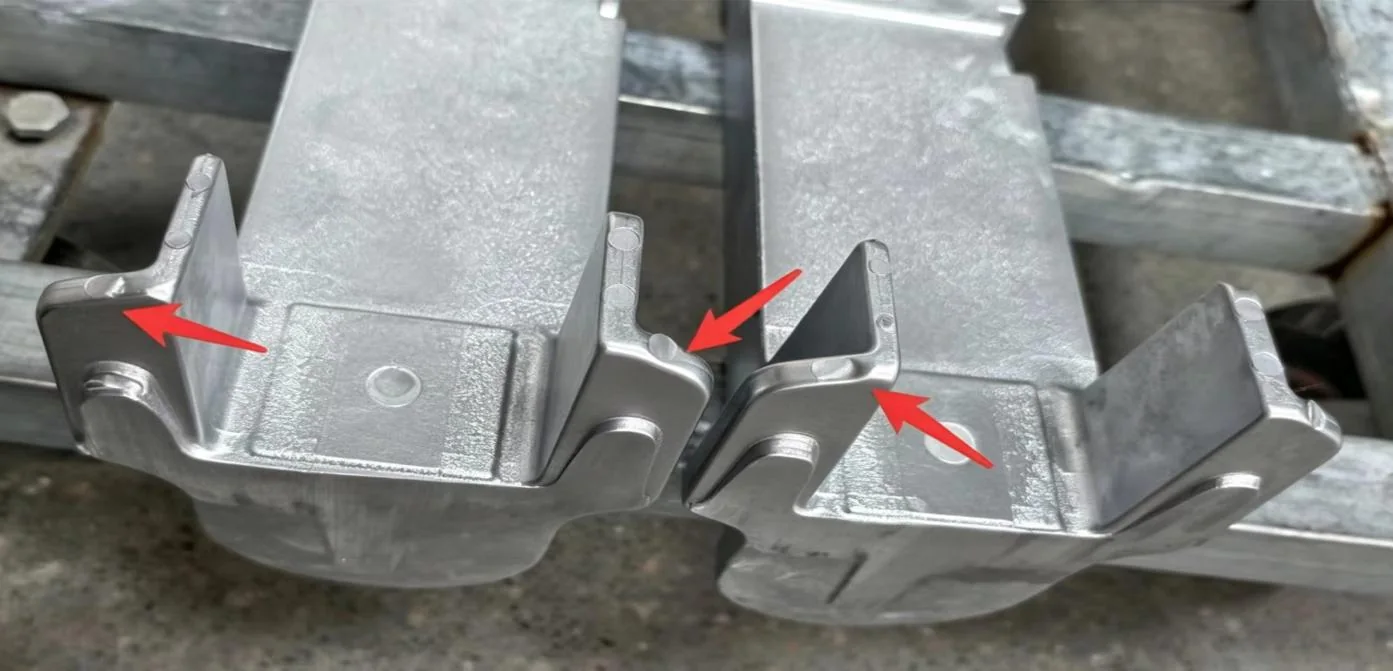
Saw Cutting
- Follow standardized gate removal locations
- Prevent excess flash from affecting subsequent operations
- Improve dimensional consistency
Grinding & Finishing
- Maintain specified machining allowances
- Inspect for minor surface imperfections during finishing
- Remove remaining burrs and excess material
- Detect cosmetic defects before machining
Integrating inspection into finishing operations allows potential quality issues to be identified earlier, reducing downstream rework.
Creating a Closed-Loop Quality Improvement Process
Rather than treating each defect as an isolated event, all corrective actions are documented and incorporated into standard operating procedures (SOPs).
The quality management system records:
- Process adjustments
- Mold modifications
- Inspection findings
- Root cause analysis
- Corrective actions
- Verification results
This closed-loop approach ensures that lessons learned during prototype development are carried forward into production, continuously improving process stability.
Benefits of Cross-Process Quality Control
A coordinated engineering and manufacturing approach provides several long-term advantages:
- Reduce recurring casting defects
- Improve prototype success rates
- Increase production consistency
- Lower scrap and rework costs
- Standardize manufacturing processes
- Support reliable high-volume production
Rather than relying on inspection alone, cross-process collaboration helps prevent quality issues before they occur.
Conclusion
Successful aluminum casting projects require more than advanced equipment-they require effective collaboration across every manufacturing process.
By connecting mold design, melting, casting, machining, finishing, and quality inspection through a structured quality management system, manufacturers can identify problems earlier, implement permanent corrective actions, and deliver more consistent aluminum castings.
For companies producing precision aluminum castings, establishing a closed-loop quality control process is one of the most effective ways to improve product reliability, reduce manufacturing risks, and achieve stable long-term production.