Engineering-driven aluminum casting and precision manufacturing solutions

K-Mold Testing How to Improve Molten Aluminum Cleanliness and Casting Quality
For both gravity die casting and low pressure casting, the cleanliness of molten aluminum plays a critical role in determining the internal quality of the final casting. Even when a casting.
For both gravity die casting and low pressure casting, the cleanliness of molten aluminum plays a critical role in determining the internal quality of the final casting. Even when a casting meets dimensional and visual requirements, excessive oxide films or non-metallic inclusions in the melt can lead to internal defects that affect machining performance, pressure tightness, and long-term reliability.
K-Mold testing is a widely used method for evaluating molten aluminum cleanliness before casting. By identifying inclusions at the melt stage, manufacturers can reduce the risk of internal casting defects and improve overall product consistency.
Why Is K-Mold Testing Important
Non-metallic inclusions can be introduced during several stages of the melting process, including:
- 1、Oxides carried in with primary aluminum or return scrap
- 2、Insufficient melt refining and degassing
- 3、Inadequate settling time after melt treatment
- 4、Incomplete slag removal before pouring
These contaminants are often invisible from the outside but may later result in porosity, inclusions, leakage, machining defects, or reduced mechanical properties.
For aluminum castings used in medical devices, industrial equipment, hydraulic components, and automotive applications, maintaining high melt cleanliness is essential for achieving consistent quality.
What Does K-Mold Testing Detect
K-Mold testing evaluates the fracture surface of a standardized test sample to identify different types of inclusions in molten aluminum.
Typical findings include:
Oxide Film Contamination – Usually caused by disturbance during sampling. These samples are considered invalid and should be retested.
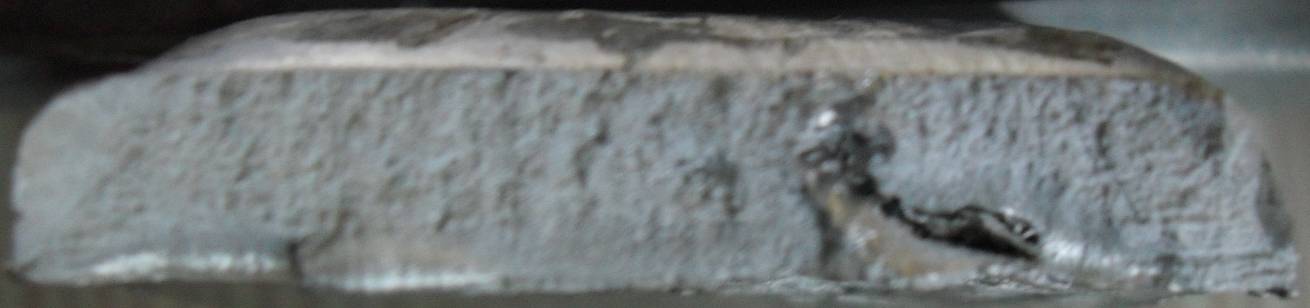
Oxide Inclusions – Indicate insufficient melt cleaning or inadequate settling time after degassing, allowing oxides to remain suspended in the melt.

Refractory or Non-Metallic Inclusions – May originate from high-melting-point contaminants or alloy segregation, potentially affecting the internal structure of the casting.

Clean Fracture Surface – A uniform, dense fracture surface with no visible inclusions, indicating good melt cleanliness.

These observations provide a rapid assessment of whether the molten aluminum is suitable for production.
Ensuring Reliable Inspection Results
To achieve consistent inspection results, K-Mold samples are prepared using standardized sampling procedures and evaluated according to established inspection criteria.
If excessive inclusions are detected, the molten aluminum undergoes additional refining and slag removal before a new sample is taken for verification. Production proceeds only after the melt meets the required cleanliness standard.
To support full quality traceability, all test samples are identified, documented, and retained according to the quality management system.
Supporting Consistent Casting Quality
K-Mold testing provides a reliable assessment of molten aluminum cleanliness and serves as an important part of melt quality control.
When combined with chemical composition analysis, tensile testing, dimensional inspection, X-ray inspection, and other quality control procedures, it helps monitor the entire manufacturing process-from melting and casting to final inspection.
By controlling inclusion defects at the source, manufacturers can improve casting density, reduce internal defects, enhance machining performance, and deliver more consistent aluminum castings for demanding applications.